Enformer#
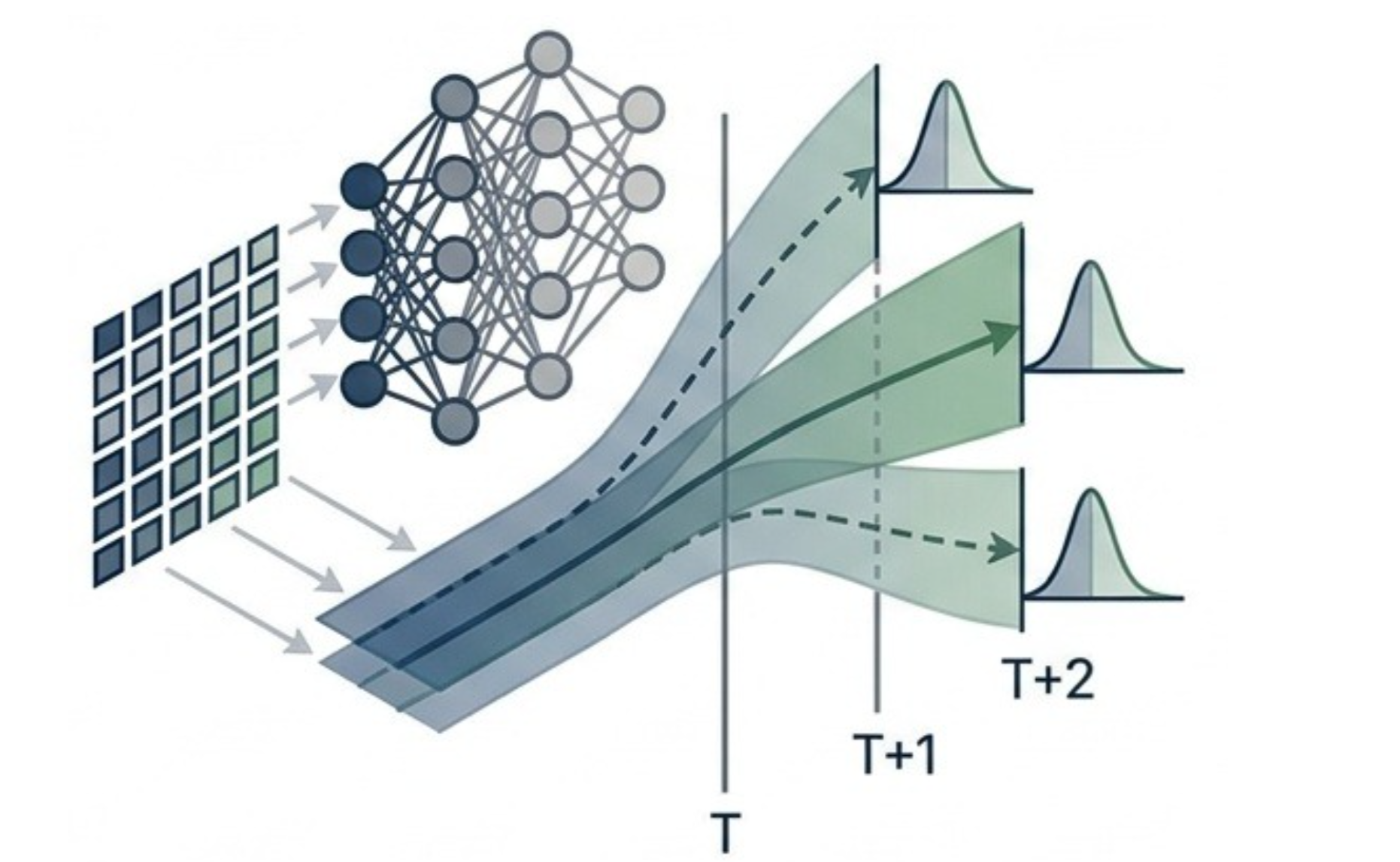
Enformer is the temporal model in Genformer. It integrates the engression (distributional regression) principle with a sequence-to-sequence Transformer to produce probabilistic multivariate forecasts.
How it works#
The look-back window is replicated into \(M\) ensemble copies.
Independent pre-additive noise \(\epsilon^{(m)} \sim \mathcal{N}(0, \sigma^2 \mathbf{I})\) is injected into each copy.
The Transformer maps each copy to a trajectory; training minimises the strictly proper Energy Score.
Because the Energy Score is a strictly proper scoring rule, minimising it drives the sampled trajectories toward the true conditional predictive distribution - no parametric likelihood assumption required.
Usage#
Enformer follows the standard Darts
fit / predict workflow over a TimeSeries:
import pandas as pd
from darts import TimeSeries
from genformer import Enformer

# 1. Load data as a Darts TimeSeries
series = TimeSeries.from_dataframe(pd.read_csv("your_data.csv"))
train, val = series[:-50], series[-50:]

# 2. Configure the model
model = Enformer(
    input_chunk_length=24,        # look-back window  (p)
    output_chunk_length=12,       # forecast horizon  (q)
    num_samples_engression=10,    # ensemble size     (M)
    noise_dist="gaussian",        # 'gaussian' or 'uniform'
    noise_std=0.1,                # noise scale        (σ)
    n_epochs=30,
)

# 3. Train
model.fit(train)

# 4. Draw a probabilistic forecast (50 sampled trajectories)
prediction = model.predict(n=12, num_samples=50)

# 5. Plot the predictive interval
prediction.plot(low_quantile=0.05, high_quantile=0.95)
Where the uncertainty comes from
Every predict call injects noise into the look-back window, so
num_samples independent trajectories are produced. Quantiles over those
samples form the predictive interval.
For a full, runnable walkthrough see Usage.
Key hyperparameters#
Argument |
Symbol |
Meaning |
|---|---|---|
|
\(p\) |
Length of the historical look-back window. |
|
\(q\) |
Forecast horizon. |
|
\(M\) |
In-sample ensemble size used to estimate the Energy Score in training. |
|
\(\sigma\) |
Scale of the injected stochastic noise. |
|
Noise family: |
API reference#
- class genformer.models.Enformer(*args, **kwargs)[source]#
Bases:
TransformerModelEnformer: A Deep Generative Transformer for Probabilistic Time Series Forecasting.
This model integrates the engression (distributional regression) principle with a sequence-to-sequence Transformer architecture. Instead of producing point predictions or relying on restrictive parametric likelihoods, Enformer directly estimates the conditional predictive distribution of future observations via noise-driven sampling.
The architecture explicitly expands the input look-back sequence into an ensemble of M replicas, injecting independent stochastic noise into each before processing through the Transformer backbone. The training optimizes a strictly proper scoring rule known as the Energy Score (ES) loss.
- Parameters:
input_chunk_length (int) – The length of the historical look-back window (( p )).
output_chunk_length (int) – The prediction horizon (( q )).
num_samples_engression (int, optional) – The number of in-sample forecast trajectories (( M )) to generate for the ensemble. Defaults to 10.
noise_dist (str, optional) – The type of noise to inject (‘gaussian’ or ‘uniform’). Defaults to ‘gaussian’.
noise_std (float, optional) – The standard deviation/scale (( sigma )) of the injected noise. Defaults to 0.1.
random_state (int, optional) – Seed for reproducibility. Defaults to 23.
save_checkpoints (bool, optional) – Whether to save PyTorch Lightning checkpoints. Defaults to False.
**kwargs – Additional parameters passed to the underlying TransformerModel from Darts (e.g., n_heads, d_model, num_encoder_layers).
output_chunk_shift (int)
d_model (int)
nhead (int)
num_encoder_layers (int)
num_decoder_layers (int)
dim_feedforward (int)
dropout (float)
activation (str)
norm_type (str | torch.nn.Module | None)
custom_encoder (torch.nn.Module | None)
custom_decoder (torch.nn.Module | None)