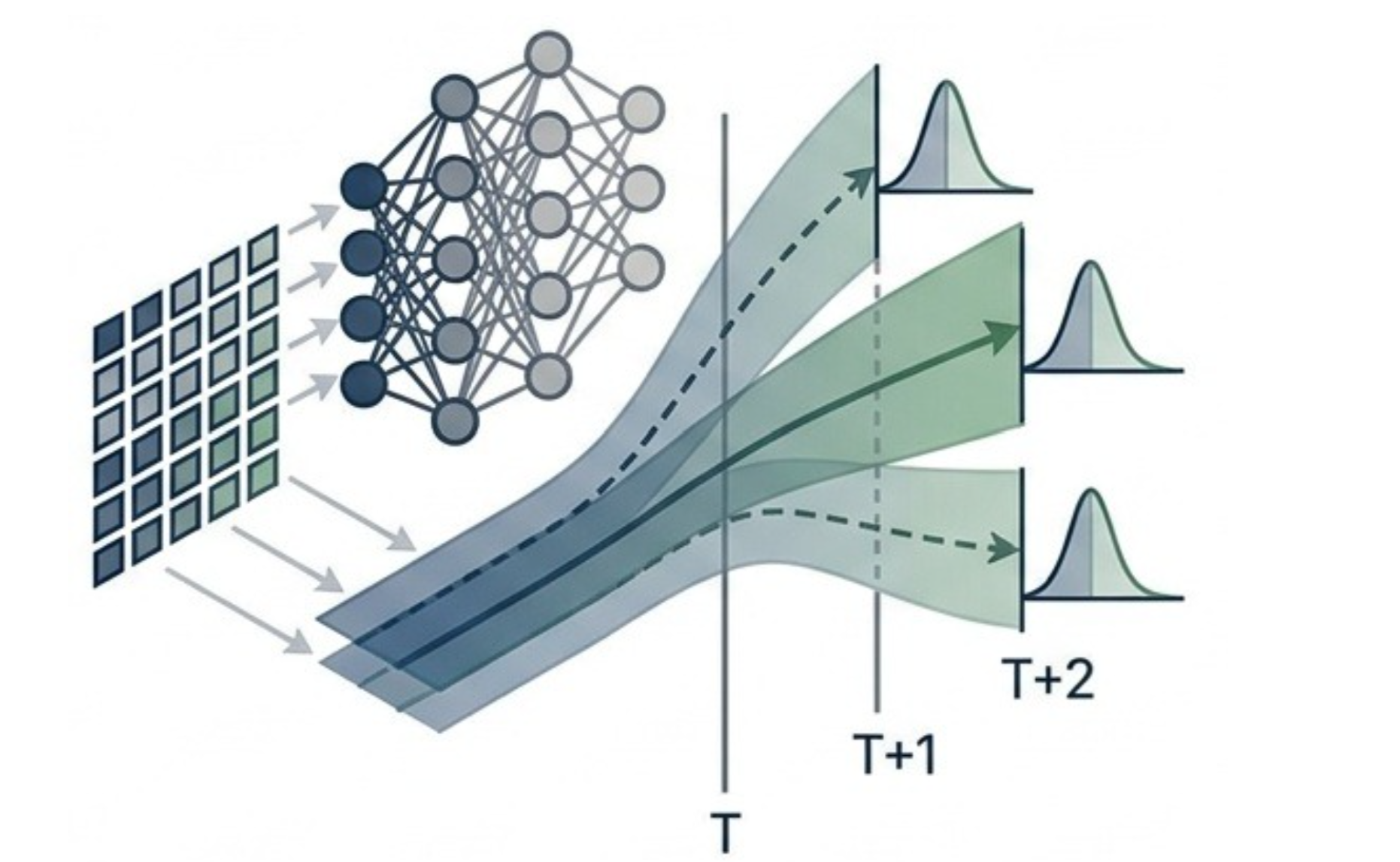
Quickstart#
From a raw TimeSeries to a probabilistic forecast in a handful of lines. For
full, runnable notebooks see Usage; for the details of each model see
Enformer and GEnformer.
Temporal forecasting with Enformer#
Enformer follows the standard Darts
fit / predict workflow.
import pandas as pd
from darts import TimeSeries
from genformer import Enformer

# 1. Load your data as a Darts TimeSeries
series = TimeSeries.from_dataframe(pd.read_csv("your_data.csv"))

# 2. Configure the model
model = Enformer(
    input_chunk_length=24,        # look-back window  (p)
    output_chunk_length=12,       # forecast horizon  (q)
    num_samples_engression=10,    # ensemble size     (M)
    noise_dist="gaussian",        # 'gaussian' or 'uniform'
    noise_std=0.1,                # noise scale        (σ)
    n_epochs=30,
)

# 3. Train
model.fit(series)

# 4. Draw a probabilistic forecast (50 sampled trajectories)
prediction = model.predict(n=12, num_samples=50)

# 5. Plot the predictive interval
prediction.plot(low_quantile=0.05, high_quantile=0.95)
How the uncertainty appears
Each call to predict injects noise into the look-back window, so
num_samples independent trajectories are produced. Quantiles over those
samples form the predictive interval.
Spatiotemporal forecasting with GEnformer#
When your series live on a graph (sensors, regions, stations), use
GEnformer. It applies a Graph Convolution over the adjacency structure
before the Transformer backbone, and forecasts in latent GCN space via
genformer.utils.generate_forecasts().
import torch
from genformer import GEnformer
from genformer.utils import generate_forecasts

# Adjacency matrix (num_nodes x num_nodes) describing the spatial graph
edges = torch.tensor([[0, 1, 1],
                      [1, 0, 1],
                      [1, 1, 0]], dtype=torch.float32)

model = GEnformer(
    input_chunk_length=24,
    output_chunk_length=12,
    edges=edges,
    num_nodes=3,
    gcn_out_feat=32,
    num_samples_engression=10,
    target_coverage=0.9,          # drives the calibration loss
    n_epochs=30,
)
model.fit(series)

# Forecast, then average over the latent dimension to get per-node forecasts
samples = generate_forecasts(model, history=series[-24:], m_samples=30)
node_forecasts = samples.mean(dim=-1).cpu().numpy()   # (M, T_out, N)
Key hyperparameters#
Argument |
Symbol |
Meaning |
|---|---|---|
|
\(p\) |
Length of the historical look-back window. |
|
\(q\) |
Forecast horizon. |
|
\(M\) |
In-sample ensemble size used to estimate the Energy Score during training. |
|
\(\sigma\) |
Scale of the injected stochastic noise. |
|
Noise family: |